
ELIZABETH PALLETT
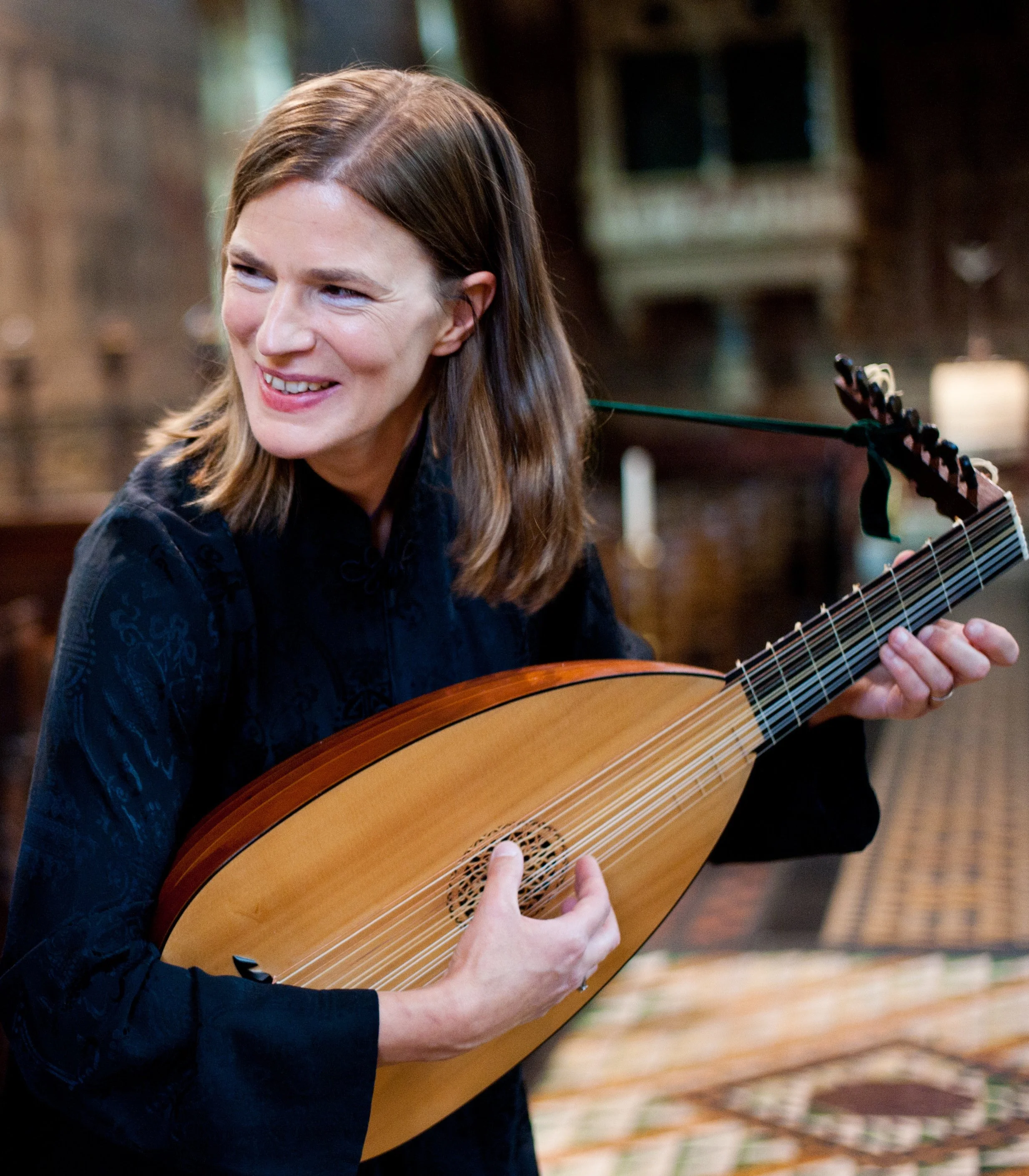
There are musicians who play historical instruments.
And then there are musicians who seem to unlock them.
Elizabeth Pallett has become an expert guide and mentor in my own pursuit of understanding the early instruments that lie along the mysterious path to the modern guitar. Along the way, she has also become a truly great friend.
Her world is filled with instruments whose names, shapes, and sounds seem to have come from another time: the many forms of the lute, early guitars, and the extraordinary theorbo—a massive, long-necked member of the lute family whose deep voice once filled the musical spaces of another age.
Each instrument has its own secrets.
Its own construction.
Its own tuning.
Its own technique.
And most importantly—
its own voice.
Elizabeth understands these instruments not simply as artifacts preserved from the past, but as living instruments. She performs on them, studies their traditions, and explores the subtle differences in construction, tuning, technique, and sound that can reveal how musicians of earlier centuries actually made music.
And this is where the story takes us deeper into the past.
If you know anything about the lute, you have heard the name John Dowland.
Four hundred years ago, Dowland died.
But somehow, his music remained.
It crossed the centuries.
His melodies can be intimate and haunting, melancholy and strangely modern—as though a voice from another world has survived the passage of time, waiting for someone to hear it again.
This year marks the 400th anniversary of Dowland’s death. Musicians and scholars around the world have been marking the occasion with concerts, recordings, performances, scholarship, and explorations of the musical world in which Dowland lived and worked.
Elizabeth has taken us into that world in her own remarkable way.
Throughout this anniversary year, she has been releasing a series of video performances devoted to Dowland’s music, accompanied by video diaries that take us beyond the performances themselves.
They lead us into the places connected with Dowland and his contemporaries—the places where they lived, walked, worked, and performed—and then bring us forward again, following Elizabeth as she performs this music today in their footsteps.
The result is more than a series of performances.
It becomes a musical trail through time.
One place.
One instrument.
One piece of music.
One voice reaching across four centuries.
Fragments of a world that should be silent by now.
And yet, when the strings begin to vibrate, something happens.
For a moment, the distance between then and now seems to disappear.
The instruments cease to be historical objects.
They become voices.
Through Elizabeth’s lutes, early guitars, theorbo, and her performances of Dowland, we are given a chance to listen for something almost impossible to recover:
the sound of the past itself.
And perhaps that is what makes Elizabeth’s work so compelling.
She isn't simply playing old music.
She is following its trail.
Through instruments.
Through manuscripts.
Through places.
Through the music itself.
Searching for traces of something that time has almost erased.
Subscribe to her youtube channel here… you won’t be sorry!